

Jitka Šálková, 2025
Abstract
This essay examines how social media recommendation algorithms and social bots influence both the information users see and the opinions they form. It is based on recent empirical and modelling studies of how recommendation algorithms and social bots work and their impact on information and opinions, prevalence and causes of echo chambers, filter bubbles, polarization and bot activity across platforms. This essay argues that algorithms do not create these negative phenomena and that they can also have positive impact. It concludes that understanding these mechanisms is essential for media and algorithmic literacy.
Keywords: social media algorithms; social bots; echo chambers; filter bubbles; opinion formation; polarization; disinformation; misinformation; social influence; confirmation bias
Introduction
Every day, people receive millions of pieces of information from social media. That is why for many people, social media have become one of the primary sources from which they obtain information. Younger generations mostly use media such as Instagram and TikTok as their source of information.
For us as consumers, it may seem that we have instant access to information without having to make much effort to find it. We simply open Instagram Reels, start scrolling, and suddenly we are exposed to everything from the latest fashion trends to political content. It feels easy and natural — as if we always see exactly what we want to see. But how is that possible? And is it not strange that we mostly encounter content that reflects our interests, preferences, or even our own opinions? Why does this happen?
The problem is that users don’t know how the content they see is generated. Social media platforms use recommendation algorithms that determine what appears on our feeds — yet many users are unaware of this. This hidden process can influence their opinions without them realizing it.
These algorithms may reinforce disinformation, polarization, stereotypes, and create echo chambers, where people are exposed only to content that aligns with their existing views. As a result, users may consume false or misleading information, which can strongly shape their thinking, perspectives on certain issues, and form their opinions.
In this essay, I begin by outlining how recommendation algorithms and social bots work. I then turn to their positive and negative impact on the information we receive as users and discuss how this can influence our thinking and shape our opinions.
Algorithmic Mechanisms
Social media have a large amount of content. For that reason, platforms must decide what to show to a specific user at a specific time. For that they use algorithms. Any large social media platform uses many algorithms. We have different algorithms for processing content and for propagating. (Narayanan, 2023) In this essay, I would like to focus on recommendation algorithms, as they are responsible for generating and shaping the content we see in our feeds on most platforms.
Narayanan (2023) in his work “Understanding Social Media Recommendation Algorithms”, emphasizes that people usually assume that algorithms are too complicated to understand. But are they? In his essay we learn that this is not exactly true. In explaining how recommendation algorithms work in this part I rely mainly on Narayanan’s (2023) work, which clearly outlines their main principles.
First, we will look at three stylized models of information propagation, shown in Figure 1:
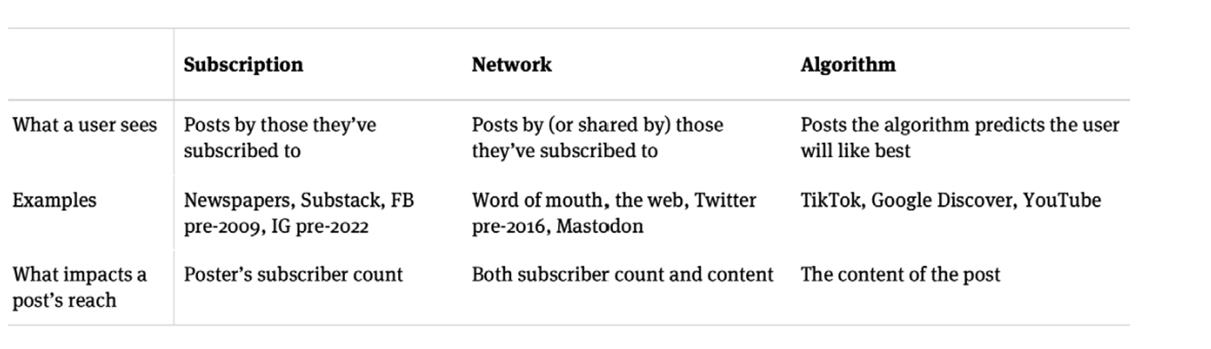
This table distinguishes three conceptual models of how information can spread on digital platforms. We have feeds based on subscription – we see posts from people we follow. Then there are network effects which enable users to reshare posts or, for example, on Twitter retweet them. But nowadays, posts that algorithms predict will be the most popular among users dominate.
An important point in this essay is that virality is unpredictable. Viral posts dominate users’ attention, but only a small fraction of posts goes viral. That means that a small number of posts gets most of the engagement. Platforms also use demotion to reduce the reach of content they consider problematic. Therefore, on algorithm-driven platforms there is a huge imbalance between popular and unpopular posts. However, on subscription-based platforms, the difference is smaller (Narayanan, 2023).
The basis of every major platform’s recommendation system is to predict how likely the user is to engage with a post. Engagement means liking, commenting, sharing, opening, watching a video multiple times etc. Engagement is the main indicator that is used to optimize user’s feed, because platforms receive constant feedback on how a user engages with a post. The main engagement is for each platform different – specific to each platform’s design. (Narayanan, 2023)
So how do algorithms predict what will be liked by users? Even though each platform’s recommendation systems use various techniques, there is a similar logic behind predicting what content to show to a user. When an algorithm wants to predict how a specific user will engage with a specific post, it tries to answer the question: “How did users similar to this user engage with posts similar to this post?” (Narayanan, 2023)
Arvind Narayanan (2023) breaks it down in his essay into two parts. First, he focuses on users’ similarity and then on similarity between posts. To determine users’ similarity there are 3 main types of signals platforms use. First, we have network signals that come from user’s connections: who they follow, whose posts they interact with, and who interacts with them. For some platforms, like Twitter, these relationships are important as the distribution of their content is determined by these signals. Then there are behaviour signals which include everything a user does on the platform: what they like, comment on, search for, watch or skip. They are the most reliable ones since users generate huge amount of these data. And the third are demographic signals. When a user is new to a platform, these data such as age, language, location or even device type can help the algorithm while there is little behavioural data about the user. Once the user starts engaging with content, demographic information becomes less important.
To determine the similarity between posts, platforms use two types of information. One important type is content features. Algorithms analyse metadata such as titles, descriptions or language and use them as attributes. So, when user likes a post, algorithms analyse its attributes (features) and look for content that shares same ones, so it can consider them similar. Algorithms also demote posts based on its features; hence its distribution will be limited. Beyond content analysis, algorithms also identify posts’ similarity through user’s behaviour: posts are considered similar when similar groups of users have interacted with them. Most platforms combine both content-based and behavioural signals in their recommendation systems. (Narayanan, 2023)
In conclusion, recommendation algorithms work on a relatively simple but very effective principle where they predict what content a user is likely to engage with and create their feed based on that.
Next to recommendation algorithms, which determine the distribution and personalization of content, also exist algorithmic systems, which influence social media in a slightly different way. Typical example of these systems are social bots. Social bots are autonomous software, sometimes powered by AI, agents who can sense, think and act – they collect data from platforms, evaluate the situation based on it and publish content, react, follow, retweet, interact – imitating human behaviour on social media. (Hajli et al., 2021)
Algorithms and Information Flow
Even though we have access to a huge volume of news content online, people only dedicate a small part of their time to it. Web tracking analyses show that in the United Kingdom, news websites account for only a small proportion of total time spent online. (Ross Arguedas et al. 2022) This suggests that for a large part of users, social networks that are controlled by algorithms are likely to be the primary source of information. But because recommender algorithms prioritize showing users the content, they are most likely to engage with, the information they are exposed to can be significantly shaped and potentially distorted.
Algorithms are usually associated with a range of negative phenomena including echo chambers, filter bubbles, disinformation and so on. But to what extent are they actually responsible for these effects? And could they have some positive impact? In this section I would like to investigate concerns that are typically associated with algorithms and look at their positive and negative impact on information that users consume from platforms.
One of the most discussed phenomena is the so-called “echo chambers”. Echo chambers represent a situation in a closed media environment, in which the messages that resonate within it are amplified while also being shielded from potential criticism and opposing perspectives. (Ross Arguedas et al. 2022) This can lead to reinforcement of group identity, the confirmation of one’s own view, and the creation of a sense of a single, unified truth.
Then we have the term filter bubble, coined by internet activist Eli Pariser in his book “The Filter Bubble: What the Internet Is Hiding from You.” As summarised by Ross Arguedas et al. (2022), Pariser argues that the algorithms of search engines and social media personalise our feeds so that we mostly see content we like, while content we might not like stays hidden from us. This can result in a highly personalised information universe that is unique to each of us and offers only limited informational diversity.
The difference between echo chamber and filter bubble is that echo chamber is a form of a closed information bubble in general, we cannot say what is the reason some people may get into it. People can enter them voluntarily, for example, so they do not necessarily arise as a result of algorithms. On the other hand, filter bubble is a type of echo chamber that is mainly caused by algorithms not by our personal choice. It is “possible outcome of specific aspects of how news and information is distributed online.” (Ross Arguedas et al. 2022)
The question is if echo chambers are a product of algorithms or human behaviour. Problem is that it is much more complicated than just blaming one side. Empirical research shows that echo chambers are much less widespread than it could be expected. In United Kingdom it is estimated that only 2–8% of users are in politically polarized online echo chambers, when in fact most people have relatively diverse media consumption. Similar results appear in other European countries and also in the USA, which is often considered highly polarised, yet a large share of users still consume news from a diverse range of sources. (Ross Arguedas et al. 2022)
Echo chambers and filter bubbles are not primarily made by algorithms, the main role in creating these phenomena is human behaviour and the structure of social relations. Algorithms tend to enhance this process. Echo chambers arise especially as a result of selective exposure, confirmation bias and homophily – people’s tendency to search and interact with information that matches and confirms their opinions. This confirms the findings of Zimmer et al. (2019), Interian et al. (2023), and Ross Arguedas et al. (2022). Hence algorithms are not the creator but only an amplifier as they increase the amount of content with a similar theme that the user identifies with based on their previous interactions, which reinforces the homogeneity of the information displayed to them; therefore, they are not the ones who create its initial emergence.
Echo chambers and filter bubbles can be significant factors contributing to polarization. Polarization is “the division of a group into sharply contrasting subgroups, communities, or sets of opinions or beliefs”. (Oxford English Dictionary) This means that people can be divided into groups by their beliefs and opinions where there is an intragroup agreement between those individuals together with an intergroup disagreement between individuals belonging into groups with different beliefs. (Interian et al. 2023)
We can detect polarization in online networking using different metrics. For example, we have homophily, which measures peoples tendency to associate with similar-thinking individuals, modularity, which quantifies the extent to which a network is divided into dense, internally connected groups with weak connections between them and random walk theory that uses probability of random browsing of the net to determine how easily information spreads between different groups. (Interian et al. 2023)
Polarization on social media does not originate from algorithms, but as a consequence of social and cognitive mechanisms. These mechanisms determine how people interact with each other and form communities together. According to Interian et al. (2023), behind polarization can stand combined effect of confirmation bias, people preferring information that agrees with their opinions and ignoring other perspectives, and social influence – people are usually influenced by people around them. While effect of these two factors can influence people’s opinions. This is closely connected to echo chambers and filter bubbles, even though they do not create polarization itself, they contribute to it by increasing the homogeneity of environment, where users consume and share content.
High polarization can influence the spread of fake news. Polarization does not build fake news but helps increase them. (Interian et al. 2023) Fake news is defined as “false stories that appear to be news, spread on the internet or using other media, usually created to influence political views or as a joke” (Cambridge Dictionary).
Fake news can be misinformation or disinformation depending on how they are spread. The difference is that misinformation is inaccurate information, that can mislead someone, but it is unintentional. According to the study “The Spreading of Misinformation Online” (Del Vicario et al., 2016), misinformation is spread mainly thanks to a selective exposure, confirmation bias, homogeneity and polarization, in which there are created closed environments, where unverified and false information can easily and quickly spread virally.
The same applies to disinformation. But in contrast “disinformation is misleading information that has the function of misleading.” (Fallis, 2015) According to Diaz Ruiz & Nilsson disinformation can be spread in two phases: firstly, false or misleading information are inserted (“seeded”) and then users themselves, for example within echo chambers, develop them and disseminate them. They can also use them to argue against different opinions, and they can confirm their group’s identity. (Diaz Ruiz & Nilsson 2023) Here applies the same idea – algorithms do not stay behind it, but they can be an accelerator for their circulation.
Even though there can be many negative influences, recommendation algorithms have also positive influence, this applies not only from the perspective of the platforms, but also for us users. Algorithms can, in certain cases, enrich the informational environment and provide access to information we might not encounter otherwise, for example, exposing users to unexpected, thematically diverse recommendations or to news content that falls outside their usual areas of interest. In this way, they can support the so-called “incidental exposure”– the random encountering with new information – thereby expanding users’ horizons across media landscape. (Ross Arguedas et al. 2022)
Now we will look at bad influence of social bots, which were interpreted in the beginning. Since they produce huge amounts of interactions like retweets, comments, mentions, they can create artificial image of popularity and controversy. They immediately react to conflicts, crises and protest, which has the effect on speeding them up. They as well create very emotional and conflicting content. The outcome of this behaviour is distortion of social signals, artificial amplification of content, acceleration of the spread of misinformation and strengthening polarization. (Salge & Karahanna 2018)
Social bots can also have some positive impact. Bots can quickly deliver up-to-date and, most importantly, true information, for example during pandemic or emergency event. Some bots can additionally support technical platform functions, for example through an automated customer service line. (Hajli et al. 2021) Thanks to its mechanism “algorithmic social transmission” they can contribute to the rapid dissemination of relevant information. (Salge & Karahanna 2018)
Algorithms and Opinion Formation
In the previous section, we looked at how recommendation algorithms can influence the information we receive through social networks. Now, we can have a look at how they can affect our opinion. We know that the information environment, created by algorithms, is not completely neutral. Some content can be favoured or suppressed, which can reshape the overall structure of social interactions.
As I mentioned previously, people’s opinions are affected by conjugate effect of confirmation bias and social influence. (Interian et al. 2023) Confirmation bias can be especially strong, as users tend to stick to their existing opinions, and change them only incrementally, and even then, they mostly accept those opinions that are similar to their original beliefs. The process of changing opinions depends on the previous state and is achieved under strong and repeated social pressure. (Xiong & Liu, 2014)
These psychological mechanisms are amplified by the way social media platforms structure our social environment. People are not randomly mixed. On social media, managed by recommendation algorithms, such as Facebook or Twitter, appears large homophily – users are being recruited according to a similar belief, that means that they interact mostly with people who have either the same or very similar opinions. (Cinelli et al. 2021) Santos, Lelkes & Levin (2021) show that “People you may know” algorithms recommend new contacts based on structural similarity. This is how strong communities, with only little contact with different groups, can be formed. This can help the formation of echo chambers, as users are mainly exposed to opinions and information from within their “bubble”, which reinforces polarization. These isolated modules create an ideal environment for the growth of more extreme opinions.
The problem is that users usually do not realize that they are in a partly filtered environment. Groot, Haan, Dijken (2023) emphasizes the problem of how younger generation perceive social media. Some young people compare the content of their feeds with reality – “what I see on social media must be – what’s really happening”. Even though they understand some basic principles of algorithms – for example, that they’ll be shown similar videos to the ones they like – they feel that algorithms actually make their experience more enjoyable. However, they’re not aware that algorithms can also have negative effects. There is an interesting example where young student said that she “does not see many things about Israel, so she guesses that nothing is happening here”, this can nicely show how younger people can view social media, while they often think that what they watch in their feed is accurate to what is actually happening.
Now we will look at how social bots can influence users’ opinions. In their study “Social Media, Sentiment and Public Opinions: Evidence from #Brexit and #USElection”, Gorodnichenko et al. 2021 investigate how Twitter bots are used as a part of robotic propaganda. One of the approaches is the targeting of specific political messages. During Brexit, bots represented only 0.24% of all accounts, and in the US election 0.2%, yet they still generated 12.4% and 8% of all tweets. This shows how big of an impact a small number of bots have. Bots can have direct impact on opinions by amplifying certain content and emotions. They can target specific messages to specific groups of people and thus create a false impression of a broad consensus. People may then mistakenly assume that their views are shared by the majority of society, which weakens their willingness to listen to other perspectives and reinforces polarization.
Liu et al. (2025) show that the behaviour of online groups and their opinion patterns are not random but, to a large extent, predictable. Using hypergraphs and LSTMs (Long Short-Term Memory) they can quite accurately estimate how a group’s collective opinion will evolve over time. This is consistent with the findings of Sobkowicz, Kaschesky, and Bouchard (2012), who model and simulate the evolution of online political opinions. If collective opinions are highly predictable, this could be very beneficial for algorithms. They could use that to target influence and subtly shape public opinion.
Conclusion
This essay has shown that social media algorithms affect information and opinions mainly indirectly, by shaping social environments in which we as users move. By observing our behaviour on social media platforms, they personalise our feeds and shape who we interact with in ways that strengthen our existing views and surround us with like-minded users.
The result is an online environment in which many users, without fully realising it, move within filtered spaces where recommendation algorithms interact with two psychological tendencies – confirmation bias, tendency to seek and believe information that confirms one’s existing views, and social influence, tendency to align one’s viewpoints with those around them. Over time, this can encourage the formation of echo chambers and lead to polarization.
This does not necessarily mean that we should abandon social media, but it is essential to be aware of how the platforms we use employ recommendation algorithms, how this shapes the information we are exposed to, and how it can ultimately influence the way we form our opinions. We should strengthen education in how recommendation algorithms work, how platforms are designed and governed, how transparent they are about these processes, and in media and algorithmic literacy more broadly. If we understand these mechanisms better, it enables us to use platforms more consciously.
Methodology
This essay draws on academic literature, including peer-reviewed articles and institutional reports. AI assistance was used for grammar checking and citation formatting.
References
Cambridge University Press. (2025). Cambridge Dictionary.
Cinelli, M., De Francisci Morales, G., Galeazzi, A., Quattrociocchi, W., & Starnini, M. (2021). The echo chamber effect on social media. Proceedings of the National Academy of Sciences.
De Groot, T., de Haan, M. J., & van Dijken, M. (2023). Learning in and about a filtered universe: Young people’s awareness and control of algorithms in social media. Learning, Media and Technology.
Del Vicario, M., Bessi, A., Zollo, F., Petroni, F., Scala, A., Caldarelli, G., Stanley, H. E., & Quattrociocchi, W. (2016). The spreading of misinformation online. Proceedings of the National Academy of Sciences.
Diaz Ruiz, C., & Nilsson, T. (2023). Disinformation and echo chambers: How disinformation circulates on social media through identity-driven controversies. Journal of Public Policy & Marketing.
Fallis, D. (2015). What is disinformation? Library Trends.
Gorodnichenko, Y., Pham, T., & Talavera, O. (2021). Social media, sentiment and public opinions: Evidence from #Brexit and #USElection. European Economic Review.
Hajli, N., Saeed, U., Tajvidi, M., & Shirazi, F. (2021). Social bots and the spread of disinformation in social media: The challenges of artificial intelligence. British Journal of Management.
Interian, R., Marzo, R. G., Mendoza, I., & Ribeiro, C. C. (2023). Network polarization, filter bubbles, and echo chambers: An annotated review of measures and reduction methods. International Transactions in Operational Research.
Javed, U., & Javed, U. (2023). The influence of social media algorithms on political polarization and public opinion. Online Media and Society.
Liu, J., Liu, Q., Li, H., Shen, W., Sun, Y., Yu, L., Zhu, L., & Shi, Q. (2025). Predicting online group opinions: A hypergraph-enhanced structure deep clustering with LSTM. Computers in Human Behavior.
Narayanan, A. (2023). Understanding social media recommendation algorithms. Knight First Amendment Institute at Columbia University.
Oxford English Dictionary. (2025). In OED Online. Oxford University Press.
Ross Arguedas, A., Robertson, C. T., Fletcher, R., & Nielsen, R. K. (2022). Echo chambers, filter bubbles and polarisation: A literature review. Reuters Institute for the Study of Journalism.
Salge, C. A., & Karahanna, E. (2018). Algorithmic processes of social alertness and social transmission: How bots disseminate information on Twitter. MIS Quarterly.
Santos, F. P., Lelkes, Y., & Levin, S. A. (2021). Link recommendation algorithms and dynamics of polarization in online social networks. Proceedings of the National Academy of Sciences.
Sobkowicz, P., Kaschesky, M., & Bouchard, G. (2012). Opinion mining in social media: Modeling, simulating, and forecasting political opinions in the web. Government Information Quarterly.
Xiong, F., & Liu, Y. (2014). Opinion formation on social media: An empirical approach. Chaos: An Interdisciplinary Journal of Nonlinear Science.