

Introduction
Selection of Topic
The topic of this semester paper was chosen in connection with the author’s long-term interest in mainly the fashion industry as well as digital platforms, and merging it with the analytical approaches within Competitive Intelligence (CI). Since the fashion industry, especially the fast-fashion segment, is one of the most rapidly evolving sectors, heavily influenced by social media, online culture, and viral content, it represents an ideal environment for applying OSINT (Open-Source Intelligence) methods. This paper therefore focuses on analysing how emerging fashion trends can be identified through publicly available online data and how such insights can support faster and more informed decision-making for fast-fashion brands.
Objective of the Paper
The main objective of this paper is to demonstrate how OSINT tools and techniques can be used to detect emerging fashion trends across social media and other publicly accessible digital platforms, and how these insights can be utilised within Competitive Intelligence for fast-fashion brands.
Research Questions
- How can OSINT tools be used to systematically detect emerging fast-fashion trends across social media and other publicly accessible digital platforms?
- Which strategic online signals (e.g., engagement dynamics, influencer activity, visual patterns, search behaviour) are most relevant for understanding the early stages of fashion trend development?
- In what ways can insights derived from OSINT-based trend monitoring support decision-making within fast-fashion retailers, particularly regarding product development, timing, and competitive positioning?
Methods Used
To achieve these objectives, the paper applies several analytical techniques and CI-relevant approaches focused on gathering and evaluating publicly available information. Specifically, the methods include:
- OSINT-based monitoring of social media platforms, including TikTok, Instagram and Pinterest, using non-personal accounts to avoid algorithmic personalisation.
- Analysis of digital trend signals, such as hashtags, viral videos, influencer content, search patterns and platform-specific aesthetics.
- Examination of e-commerce platforms (e.g., Shein) to observe how retailers respond to emerging trends through product offerings.
- Review of industry reports, academic sources, and media articles related to fashion trends, digital behaviour and consumer culture.
- Competitive intelligence interpretation, linking collected signals to potential strategic implications for fast-fashion brands.
In addition, AI tools were used as part of the research process to support the identification of relevant sources and theoretical frameworks. The author used prompt-based searches such as “fast-fashion trends”, “fast fashion trends”, “social media”, “OSINT”, and “OSINT tools” to locate credible academic publications, industry analyses and digital intelligence resources. AI was also used to assist in structuring the paper and refining the clarity of the written text. All analytical conclusions and the final interpretation of findings are the author’s own.
1 Theoretical Framework
1.1 The Fashion Industry
The fashion industry is one of the most rapidly evolving sectors, heavily shaped by trends and the dynamics of social media. Few industries are as dependent on online culture, influencers, and viral content to stay relevant. Trend cycles have become extremely short, especially with platforms like TikTok and Instagram accelerating the creation and spread of new aesthetics. Because competition in the fast-fashion segment is exceptionally strong, major brands such as Zara, H&M, Bershka, and Pull&Bear must remain constantly alert to emerging trends in order to meet customer expectations and maintain their market position.
1.2 The Role of OSINT in Fashion Trend Monitoring
Open-Source Intelligence (OSINT) refers to the process of collecting, monitoring, and analysing information that is publicly available on the internet in order to produce actionable insights (European Union, 2022). In the context of the fashion industry, OSINT means systematically tracking data from social media platforms, online communities, search trends, e-commerce listings, influencer content, and other openly accessible sources to understand what consumers are paying attention to and which styles are gaining traction. Unlike traditional market research, OSINT allows brands to detect emerging trends in real time, observe how quickly they spread across platforms, and identify the key creators or audiences behind them. For fast-fashion brands operating in an extremely competitive environment, OSINT becomes a practical tool for anticipating shifts in customer preferences and reacting to them faster than competitors.
1.3 Fast Fashion Dynamics
Even if we take the definition of fast fashion – “an approach to the design, creation, and marketing of clothing fashions that emphasizes making fashion trends quickly and cheaply available to consumers” (Merriam-Webster, 2025), we can already see that everything about fast fashion depends on moving quickly. With fast fashion, the emphasis on “fast” is not metaphorical: the industry must be fast in identifying trends, fast in analysing consumer behaviour, fast in producing new garments, and fast in marketing them before the trend fades. This constant acceleration highlights why the ability to monitor online environments and detect emerging patterns in real time is essential. In this context, OSINT provides brands with the necessary agility to keep up with an industry where reacting even a few days late can mean missing the trend entirely. Actually quite the opposite, fashion brands and retailers need to know in advance so that they can prepare for the trend in advance.
2 Defining the Competitive Intelligence in Fast Fashion
Fast-fashion brands operate in an environment where rapid shifts in consumer behaviour and market conditions make decision-making critical and difficult. According to The State of Fashion 2026 report, fashion executives increasingly view the industry as defined by “constant change,” with trade disruptions, volatile demand, and technology-driven shifts forcing brands to adapt at unprecedented speed (Business of Fashion & McKinsey & Company, 2025). The report highlights that agile brands able to react quickly to market signals are most likely to emerge as winners, especially as consumer behaviour becomes more unpredictable and trend cycles accelerate. This reinforces that decisions related to production planning, assortment choices, sourcing, and communication cannot rely on slow or static information. Instead, fast-fashion companies must continuously monitor real-time data from online platforms, social media, and global supply environments to stay aligned with rapidly moving trends and shifting consumer expectations.
2.1 Important Data and Information
But what information do companies actually need to monitor in order to stay alive? We are talking mainly about following social media like Instagram, TikTok and Pinterest. Instagram and Pinterest have been sources of inspiration for a while, but when TikTok entered, we could essentially say that it changed the game. TikTok is a massive, fast-paced short-video platform, with data showing that 77% of its users are under 30 years old, making it particularly influential among younger demographics (Liu, 2022). On TikTok, trends and even fashion trends spread quickly among large groups of people who are easily influenced, the algorithm makes it easy for users to see a high volume of content for a particular trend.
2.1.1 Social Media
Particular information monitored on social media includes emerging trends and microtrends related to colours, materials, patterns, cuts, styles, and complete aesthetics. Viral videos, hashtags, and influencer activity act as early indicators of shifts in consumer interest and can reveal which looks are gaining attention online. Fast-fashion brands also track high-end designers, as luxury runways often inspire trends that quickly filter into mainstream markets. Beyond visual trends, however, companies must also monitor broader patterns in consumer behaviour to understand what customers engage with, what they ignore, and how their preferences change across different platforms. But overall, it is also important to monitor consumer behaviour. Fashion retailers now actively use AI-powered analytics to understand consumer preferences, improve product development, and personalise assortments, because “fashion brands and retailers need to develop, manufacture, and sell styles that resonate with consumers” in real time (Oh, 2021).
2.1.2 Other Sources of Information
However, fashion retailers often need to go beyond monitoring and predict trends. Predicting emerging fashion trends requires integrating information from multiple sources, including retailers, social media, manufacturers, and online shops, and analysing public online communication, images, and influencer content to identify upcoming styles (Checco et al., 2017).
Beyond social media, competitive-intelligence specialists must also monitor wider cultural and societal influences that can spark or accelerate fashion trends. Trends often emerge from sources such as pop culture, television series, music, films, celebrity appearances, and even political or economic events, all of which can shape what consumers find desirable (GlamObserver, 2025). Trends frequently start when a particular style, colour, or aesthetic appears repeatedly across different cultural touchpoints, not only online but also in mainstream media and public life. This means that effective trend monitoring in fast fashion requires integrating insights from multiple environments, not just digital platforms, to capture the early signals that may later evolve into major online or commercial trends.
2.2 Strategic Online Signals Relevant for Detecting Fast-Fashion Trends
Strategic online signals represent patterns, shifts, and irregularities that reveal the early stages of trend formation long before such trends become visible in product sales or mainstream media. These signals arise from how users interact with content and how platforms circulate and boost that content, offering a clearer view of the direction and speed of emerging cultural shifts. These early stages are especially important for fashion retailers, as they allow brands to prepare in advance and be ready to act when the trend reaches its peak.
One of the most important strategic signals is acceleration, meaning the rate at which an aesthetic, motif, or cultural reference begins to spread across platforms. Research on digital trend diffusion suggests that the velocity of online engagement often predicts whether a style will evolve into a larger trend or remain a short-lived micro-phenomenon (Xue et al., 2023). Sudden spikes in content creation, rapid increases in mentions, and unusually high engagement relative to the size of a community indicate that a trend may be gaining momentum. In contrast, slow and inconsistent growth often suggests limited potential for broader adoption.
Key engagement metrics harvested from platforms such as TikTok, Facebook, and Instagram are used to predict sales and trends. These strategic signals include the number of likes, comments, and shares for a specific fashion item. Importantly, not all signals carry the same weight: comments tend to provide richer feedback than likes, which require minimal effort, while shares represent a stronger endorsement and broader content visibility. By assigning different weights depending on the social network and the target demographic, for example giving more weight to TikTok when forecasting items aimed at teenagers, the model calculates a weighted engagement score. This score is then combined with operational data (e.g., item attributes, historical sales) to generate a sales forecast (Koren et al., 2024).
Monitoring influencer content is therefore a highly strategic component of trend detection, as influencers often act as early amplifiers of new aesthetics across social media. For instance, dedicated fashion bloggers with highly specialised fashion content (approximately 90%) are significantly more popular among consumers who search for fashion information daily, indicating a reliable source for emerging trends among “fashionistas” (Tomovska, 2020). At the same time, local influencers provide important signals about how trends are accepted within specific communities. Because they are closely connected to their local audiences, they can influence which styles gain traction or remain relevant in their social groups, even after the global interest in a trend begins to fade. Taken together, these influencer-driven signals show that trend development happens on several levels, both globally and locally, making the monitoring of influencer activity a key part of strategic competitive intelligence in the fast-fashion industry.
3 Practical Examples of Trend Detection Using OSINT
3.1 Glamour Trend
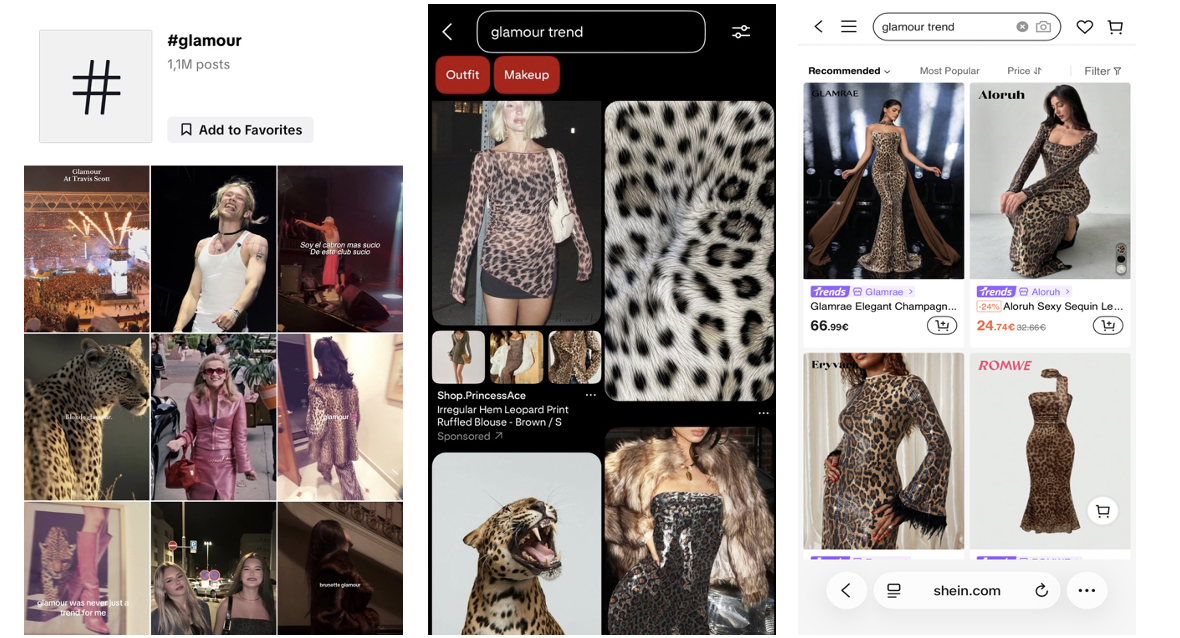
Glamour trend is a trend which started in mid-2024, with the song ГЛАМУР (“Glamour”) by the artists uniqe, nkeeei & ARTEM SHILOVETS, featuring Wipo which was released on 21 June 2024 (Apple Music, 2024).This song triggered the Glamour Trend, which under the hashtag #glamour now has over 1.1 million posts. The Glamour Trend typically features people dressing in leopard print and lip-syncing to the song.
Although the original meaning of the word glamour refers to “the quality of being fascinating, alluring, and charming, often creating an impression of exciting luxury or beauty that intensifies reality” (Merriam-Webster, 2025), the trend reinterpreted the concept almost entirely through the use of leopard-print clothing. As a result, fashion retailers and social media platforms have adopted this association and searching for terms such as “glamour” or “glamour trend” now mostly returns leopard-print outfits, even though these elements are not inherently connected.
As the trend grew throughout 2024, many users wanted to create their own Glamour videos by singing the song while dressed in leopard print. The aesthetic even became a popular choice for Halloween costumes, and overall interest in leopard print increased noticeably during this period. It is also important to note that I conducted all searches using a non-personal account to avoid algorithmic personalization that could influence the results. On Pinterest, one of the monitored platforms, sponsored advertisements from fast-fashion retailers such as PrincessAce, which is also a fast-fashion retailer, appeared prominently, promoting leopard-print clothing directly connected to the Glamour Trend.
3.2 Clean Girl Aesthetic

The Clean Girl Aesthetic is a trend that has been evolving on social media since approximately 2021 and continues to be highly relevant. Unlike fast, short-lived microtrends that peak within days or weeks, the Clean Girl Aesthetic represents a more stable and long-lasting visual identity. Under the TikTok hashtag #cleangirlaesthetic, there are over 585,000 posts, illustrating its sustained popularity over several years. The Clean Girl Aesthetic embodies more than a style, it represents a whole identity. As a result, fashion retailers are able to generate significant profit from consumers who adopt this aesthetic.
This aesthetic is characterised by minimalism, simplicity, and an intentionally effortless appearance. Typical elements include slicked-back hairstyles, natural makeup, neutral tones, gold jewellery, basic tank tops, oversized sweaters, and structured blazers. Hailey Bieber is widely recognised as one of the key public figures associated with this aesthetic, largely due to her signature polished look, natural-glow makeup, and minimalist off-duty style (Allen, 2025). Her brand Rhode Skin resonates with this aesthetic by promoting soft-glow skincare, neutral colour palettes, and clean packaging, further shaping how the trend is interpreted and adopted online.
Fast-fashion brands have also played a significant role in defining and normalising the Clean Girl Aesthetic. Retailers such as Zara, H&M, Mango, and Shein have consistently incorporated neutral basics, clean silhouettes, and minimalist pieces into their collections in response to the trend’s popularity. These brands effectively helped establish the aesthetic as mainstream by offering affordable versions of the garments seen on influencers and celebrities. On platforms like Shein, for example, searching for “Clean Girl Aesthetic” returns curated selections of simple, neutral-toned pieces, demonstrating how fast-fashion retailers use trending aesthetics as a basis for product development and marketing.
The Clean Girl style extends beyond fashion, integrating beauty, lifestyle, and wellness elements such as skincare routines, smoothie bowls, neatly organised spaces, and soft natural lighting, making it a holistic aesthetic rather than a single clothing trend. On TikTok, the aesthetic frequently appears in “Get Ready With Me” and daily routine videos, while Instagram highlights curated outfit photos and beauty shots. Pinterest showcases visual “moodboards” featuring neutral outfits, minimal accessories, and calm lifestyle imagery. To avoid algorithmic personalisation, all screenshots used for OSINT collection were captured using a non-personal account to ensure an objective view of the aesthetic across platforms.
Because this trend is not tied to a single viral event or short-lived moment but rather reflects a broader cultural preference for minimalism and “clean” living, it has remained relevant far longer than many microtrends driven by TikTok virality.
3.3 Summary of Findings
The analysis of both trends demonstrates how essential continuous OSINT monitoring is for fast-fashion brands operating in a rapidly evolving digital landscape. The Glamour Trend shows how quickly a microtrend can emerge from a single viral stimulus: a song released in mid-2024 triggered a sudden surge in user-generated content and a widespread adoption of leopard print. As this momentum spread, leopard print became one of the defining trends of the second half of 2024, confirmed by mainstream fashion media, for example, Elle published the article “Forget Quiet Luxury—Leopard Print Is Fiercely Taking Over” shortly after the trend exploded on social media (Rexroat, 2024). In such cases, OSINT allows brands to detect fast-rising demand and adjust production and marketing in real time.
In contrast, the Clean Girl Aesthetic represents a slower, more enduring trend shaped by influencers, celebrities, and broader lifestyle preferences. Its longevity is reflected not only in sustained engagement across social media but also in continued media commentary. British Vogue explored its persistence in “Why The Clean Girl Aesthetic Refuses to Die” (Jones, 2025), while Vogue Hong Kong highlighted its shifting cultural relevance in “The Clean Girl Is Out, The Mob Wife Is In” (Lam, 2024). These repeated analyses illustrate that the aesthetic remains a stable point of reference for consumers, requiring brands to continuously track subtle changes in styling, beauty routines, and lifestyle imagery to keep product offerings aligned.
Together, these examples show that OSINT enables fashion companies to capture both rapid viral spikes and longer-term aesthetic movements. By monitoring hashtags, influencer output, media coverage, and retailer responses, fast-fashion brands can make more informed decisions about product development and timing. In an industry where even a short delay can mean missing an entire trend cycle, OSINT functions as a critical competitive asset.
Conclusion
Given the author’s regular engagement with fashion content online, there was a particular interest in examining how fast-fashion retailers process the rapid flow of digital information and convert it into timely strategic decisions. Through the research process, it became clear that the mechanisms behind trend detection are far more structured and data-driven than they might appear from a consumer perspective. By analysing how openly available online information can be monitored and interpreted, the thesis highlighted the increasing relevance of OSINT as a practical tool within the fast-fashion industry.
The findings showed that trends develop through the interaction of multiple online signals, including engagement dynamics, visual patterns, influencer amplification, search behaviour, and commercial responses. Considering these signals in combination rather than in isolation provides a more comprehensive understanding of how online aesthetics progress from early emergence to widespread adoption. The case studies demonstrated that while trends may vary considerably in pace and scale, some spreading rapidly through viral momentum, others evolving more gradually through sustained cultural interest, they nonetheless follow identifiable patterns that can be observed and interpreted in real time.
Overall, the research indicated that OSINT offers a systematic framework for navigating an environment defined by rapid change and high competitiveness. Although it cannot remove uncertainty from digital culture, it equips fast-fashion brands with the ability to recognise meaningful signals earlier, respond more effectively to shifts in consumer interest, and operate with greater agility. The thesis therefore underscores the growing importance of digital intelligence for organisations within fast fashion, as trend cycles continue to accelerate across online platforms.
List of Sources
Allen, O. (2025, May 29). Hailey Bieber’s clean-girl LBD is fit for a billionaire. Vogue. https://www.vogue.com/article/hailey-bieber-clean-girl-lbd-is-fit-for-a-billionaire
Business of Fashion, & McKinsey & Company. (2025). The State of Fashion 2026 [PDF]. https://www.mckinsey.com/industries/retail/our-insights/state-of-fashion-2026
cb & Benzy. (2025). Glamour [Song]. On Glamour [Album]. Coveret Music. https://music.apple.com/us/album/glamour/1752600385
Checco, A., Demartini, G., Loeser, A., Arous, I., Khayati, M., Dantone, M., Koopmanschap, R., Stalnov, S., Kersten, M., & Zhang, Y. (2017). FashionBrain Project: A vision for understanding Europe’s fashion data universe. arXiv. https://doi.org/10.48550/arXiv.1710.09788
European Union. (2022, May 2). What is OSINT: Open-source intelligence? Data.europa.eu. https://data.europa.eu/en/publications/datastories/what-osint-open-source-intelligence
Glam Observer. (2025). How do fashion trends start? https://glamobserver.com/how-do-fashion-trends-start/
Jones, D. (2025, February 26). Why the clean girl aesthetic refuses to die. British Vogue. https://www.vogue.co.uk/article/why-the-clean-girl-aesthetic-refuses-to-die
Koren, M., Monsonego, A., & Biton, R. (2024). The influence of social network on forecasting in fashion industry. Journal of Textile Science & Fashion Technology, 11(1). https://doi.org/10.33552/JTSFT.2024.10.000752
Lam, C. (2024, February 21). The clean girl is out, the mob wife is in. Vogue Hong Kong. https://www.voguehk.com/en/article/fashion/mob-wife-aesthetic/
Liu, K. (2022). Research on the core competitiveness of short video industry in the context of big data—A case study of Tiktok of Bytedance Company. American Journal of Industrial and Business Management, 12(4), 703–719. https://doi.org/10.4236/ajibm.2022.124036
Merriam-Webster. (2025). Fast fashion. In Merriam-Webster.com Dictionary. https://www.merriam-webster.com/dictionary/fast%20fashion
Oh, K. (2020). The roles of data analytics in the fashion industry. Journal of Textile Engineering & Fashion Technology, 6(3), 102–104. https://doi.org/10.15406/jteft.2020.06.00237
Tomovska, E. (2020). The role of Instagram influencers as a source of fashion information. Tekstilna Industrija, 4, 58–64. https://doi.org/10.5937/tekstind2004058T
Xue, Z., Li, Q., & Zeng, X. (2023). Social media user behavior analysis applied to the fashion and apparel industry in the big data era. Journal of Retailing and Consumer Services, 72, 103299. https://doi.org/10.1016/j.jretconser.2023.103299