

Median annual salaries (2019–2024) provide a clear indication of how competitive different academic fields are in the U.S. doctoral labor market. This report examines salary growth across disciplines, differences between employment and postdoctoral paths, and how these trends relate to long-term research funding patterns from 2010–2023.
How have the relative competitiveness and priorities of academic disciplines in the United States evolved over the past decade? This guiding question motivates the present study, which examines long-term patterns in both labor-market outcomes and research investment. Using data from the National Center for Science and Engineering Statistics (NCSES), the analysis focuses on two key indicators of competitiveness: the median basic annual salaries of doctorate recipients with definite postgraduation plans, and the levels of research and development (R&D) funding allocated to each field. Together, these metrics offer a comprehensive view of how different disciplines have gained or lost prominence within the U.S. academic and research landscape.
The first indicator—median annual salaries—reflects the economic value and demand for expertise in each discipline. The analysis focuses on doctorate recipients in the United States from 2019 to 2023 , considering differences by field of study, type of postgraduation plan (employment or postdoctoral study), and sex. Examining these patterns provides insights into how financial incentives and professional opportunities have shifted across academic and professional domains in recent years.
The second indicator, R&D funding , serves as a proxy for institutional and societal investment in research within each field. Funding may originate from a range of internal and external sources, including businesses, government agencies, higher education institutions, and non-profit organizations. By tracking changes in R&D funding from 2010 to 2023 , the study aims to identify long-term trends that reflect which areas of research are receiving greater financial support and attention.
The research encompasses both science and engineering fields —including agricultural sciences; biological and biomedical sciences; computer and information sciences; engineering; geosciences, atmospheric sciences, and ocean sciences; health sciences; mathematics and statistics; physical sciences; psychology; and social sciences—as well as non-science and engineering fields , such as business management and administration, education, humanities, and visual and performing arts.
Through the combined analysis of salary and funding data, this study seeks to provide a comprehensive understanding of how competitiveness and priorities within the US academic and research landscape have evolved over time.
Competitiveness within academic and research fields is commonly understood as the relative ability of a discipline to attract talent, funding, and long-term career opportunities. Fields that offer higher salaries, stronger employment prospects, or more substantial research budgets tend to draw greater institutional attention and a larger share of researchers. In this sense, competitiveness reflects both labor-market dynamics and strategic research priorities, linking individual incentives with broader national investments (OECD, 2015).
In labor-market research, salary levels are widely used as an indicator of demand for specialized expertise. Higher median salaries typically signal that employers face competition for qualified workers or that the field provides significant economic or societal value. Variations in salary growth across disciplines therefore reveal how the relative attractiveness and market relevance of different fields evolve over time (NSF, 2023).
Research and development (R&D) funding represents another critical dimension of competitiveness. R&D investment is broadly interpreted as a measure of institutional commitment to advancing research capacity and supporting innovation. Fields that receive large and growing financial resources tend to have stronger research ecosystems, better infrastructure, and more opportunities for scientific progress. Long-term changes in R&D funding patterns illustrate how national priorities shift in response to technological, economic, or societal challenges (OECD, 2023).
Taken together, salaries and R&D funding provide complementary perspectives on the competitiveness of academic fields. Salary levels capture individual labor-market incentives, revealing how the value of expert knowledge changes over time. Funding trends, by contrast, reflect structural priorities and long-term institutional strategies. When analyzed jointly, these indicators offer a comprehensive picture of how disciplines gain or lose prominence within the broader U.S. research and innovation system.
The datasets used in this research are published by the National Center for Science and Engineering Statistics (NCSES), the primary federal statistical agency responsible for collecting data on the U.S. science and engineering workforce and research funding. NCSES data are widely used in academic, economic, and policy research due to their methodological consistency, national coverage, and reliability (NCSES, 2024).
Median and annual salaries
The National Center for Science and Engineering Statistics (NCSES) provides comprehensive data on the median basic annual salaries of doctorate recipients in the United States who have definite postgraduation plans. These data are categorized by field of study, type of postgraduation plan (employment or postdoctoral study), and sex, allowing for a nuanced analysis of salary distribution across different disciplines and demographic groups. Covering the period from 2019 to 2023, this dataset offers valuable insights into evolving market trends, salary growth, and the relative desirability and competitiveness of various fields.
This part of the research examines salary trends between 2019 and 2023, focusing on changes in median annual salaries across scientific and non-scientific disciplines. The analysis further explores differences by postgraduation plans—distinguishing between those entering employment and those pursuing postdoctoral study—as well as by gender, in order to assess patterns of equity and representation. By identifying variations in salary developments across time and categories, this section aims to provide a clearer understanding of how economic outcomes reflect the broader competitiveness and attractiveness of each field within the U.S. academic and professional landscape.
Understanding the Categories
The Total with definite plans category represents the median basic annual salary for all doctorate recipients in a given field who indicated a clear postgraduation plan, whether that plan involves direct employment or further postdoctoral study. This measure provides an overall picture of salary outcomes among individuals who have successfully transitioned into the next stage of their professional or academic careers.
The Employment total refers specifically to recipients whose definite plan was employment in a non-postdoctoral position. These salaries typically reflect positions in academia, industry, government, or nonprofit organizations, and serve as an indicator of the market demand and compensation for advanced expertise within each field.
The Postdoctoral study total, by contrast, represents the median salary for those whose definite plan was a postdoctoral appointment. Postdoctoral positions generally emphasize continued research training and scholarly development rather than immediate entry into the labor market. Comparing this category with employment salaries highlights differences in compensation between research-focused career paths and other professional trajectories.
Note: All values are in thousands (K).
Changes in Field Classifications
A notable shift occurred in 2021, when NCSES redefined several categories:
- Removed fields: Economics, Social Sciences, Physics & Astronomy, Life Sciences, Chemistry.
- New fields introduced:
- Computer and Information Sciences (previously grouped with Mathematics & Computer Sciences in 2019–2020).
- Multidisciplinary/Interdisciplinary Sciences.
- Visual and Performing Arts.
These changes reflect the evolving academic and labor market landscape, highlighting the growing importance of computing, interdisciplinary work, and creative industries.
Salary Trends (2019–2024)
When comparing the earliest available data to 2024, we see clear patterns of growth in some fields and decline in others.
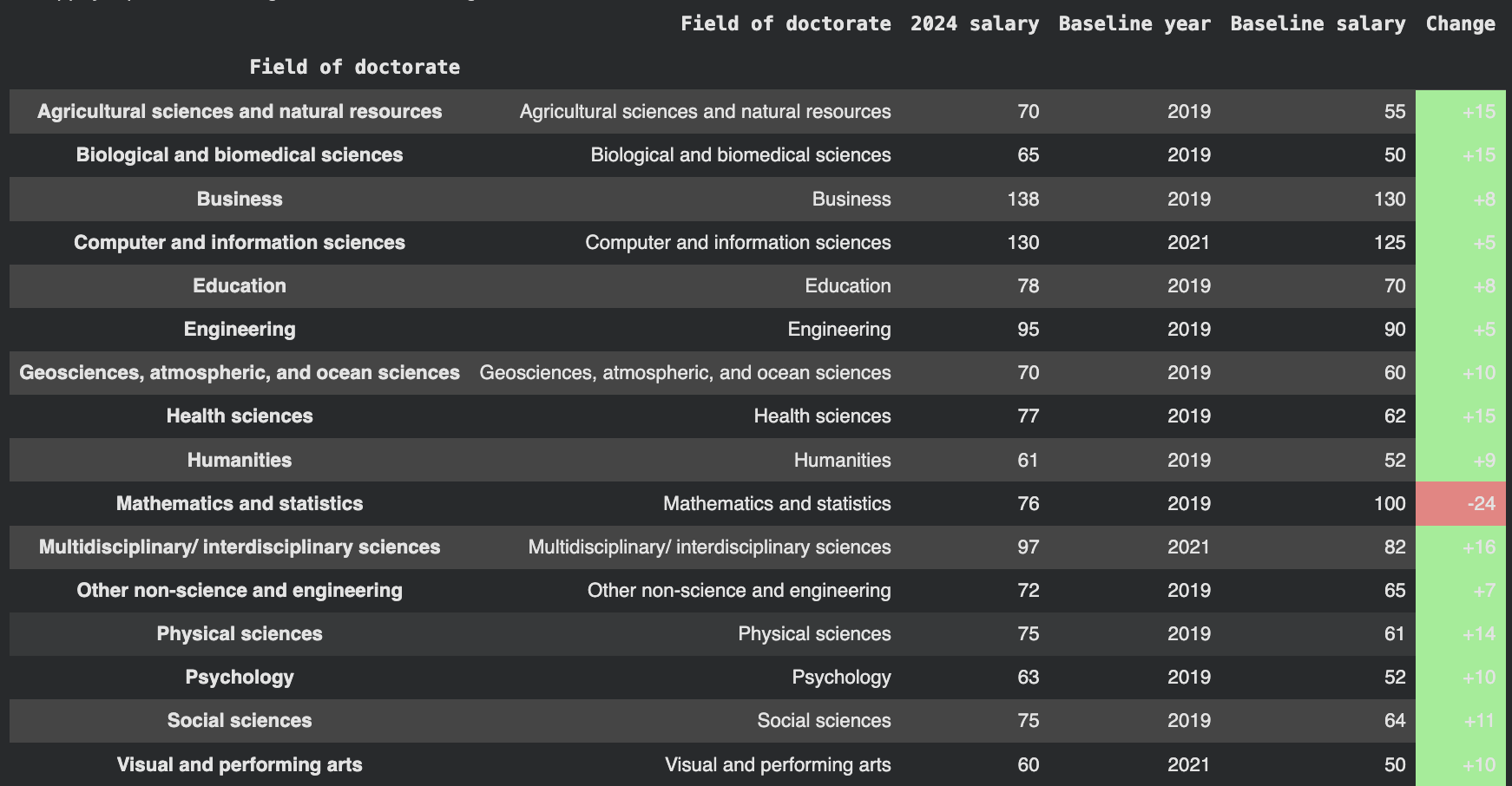
When comparing the earliest available data to 2024, we see clear patterns of growth across almost all fields (some stronger, some weaker), with the only decline in Mathematics and Statistics.
- The strongest increases were observed in: Multidisciplinary/Interdisciplinary Sciences, Agricultural Sciences & Natural Resources, Biological & Biomedical Sciences, Health Sciences, and Physical Sciences .
- Moderate increases (around +8K) occurred in: Business, Education, Humanities, and Social Sciences .
- Weak increases were seen in Engineering and Computer & Information Sciences , despite their already high absolute salary levels (95K and 130K respectively).
- The only decline occurred in Mathematics & Statistics , which fell sharply by −24K, dropping from 100K in 2019 to 76K in 2024.
These results suggest that Natural and Applied Sciences , especially health- and nature-related fields, are experiencing rising demand and are trying to attract specialists with higher salaries. In contrast, IT specialties , while still commanding high salaries, have seen limited growth, indicating a possible plateau. The decline in Mathematics and Statistics may reflect a shift in the labor market: pure mathematical skills are no longer sufficient on their own to remain competitive. Instead, employers increasingly expect complementary expertise in areas such as data analytics, computer science, and applied computational methods .
Average Doctorate Salaries
To understand how doctoral salaries developed depending on postgraduation plans, three categories were compared: doctorate recipients with definite plans overall, those who secured employment excluding postdoctoral positions, and those who entered postdoctoral research roles. The results reveal not only how salaries changed between 2019 and 2024, but also how strongly the outcomes differ depending on the chosen path.
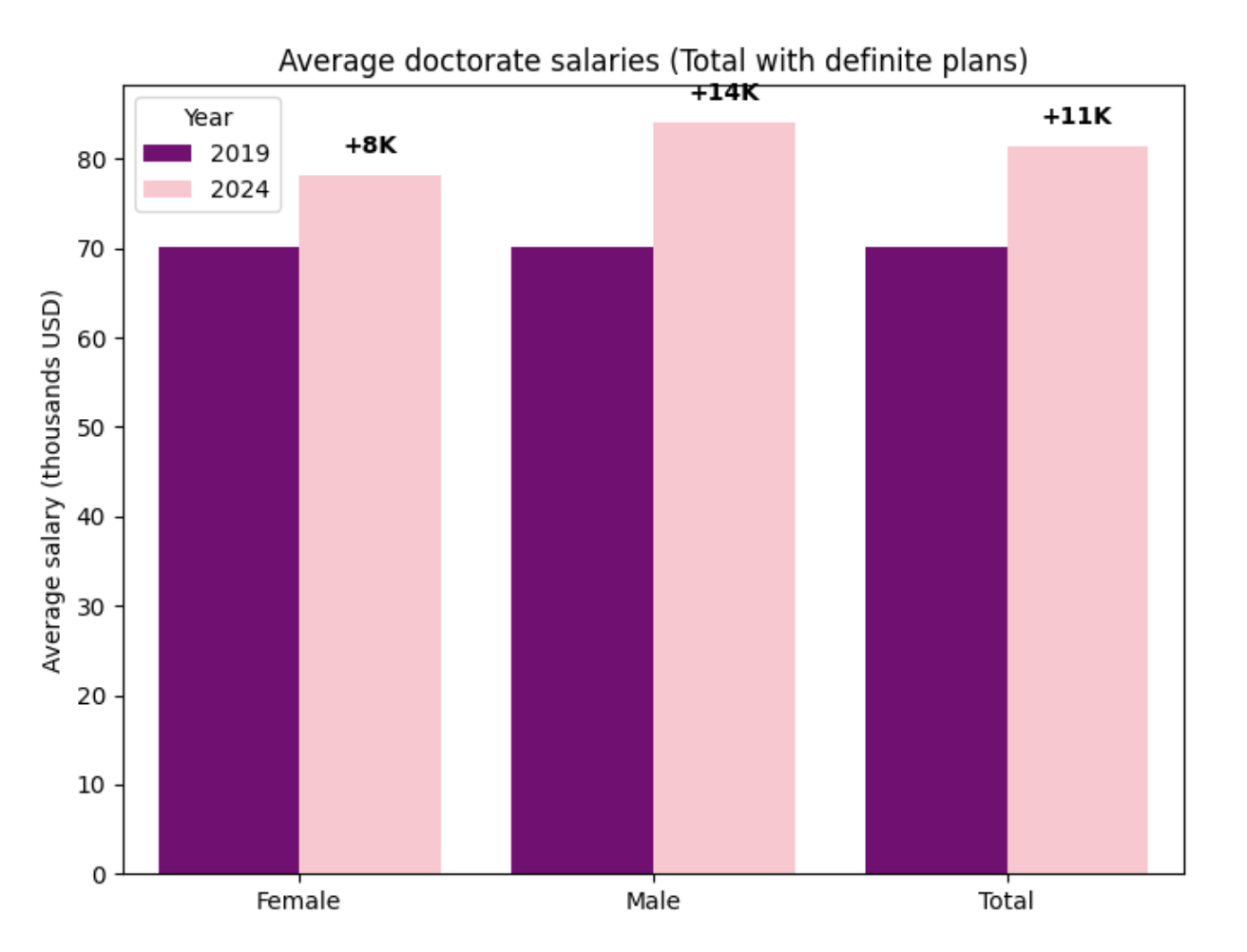
For doctorate recipients with definite postgraduation plans, the average salary showed steady improvement over the period. Female recipients increased their median pay from about $70,000 in 2019 to $78,000 in 2024, while male recipients rose from $70,000 to $84,000. Taken together, this represents an overall increase of $11,000 for the group. The stronger growth for men compared to women indicates that gender differences in compensation remain present even among those with similar levels of educational attainment.
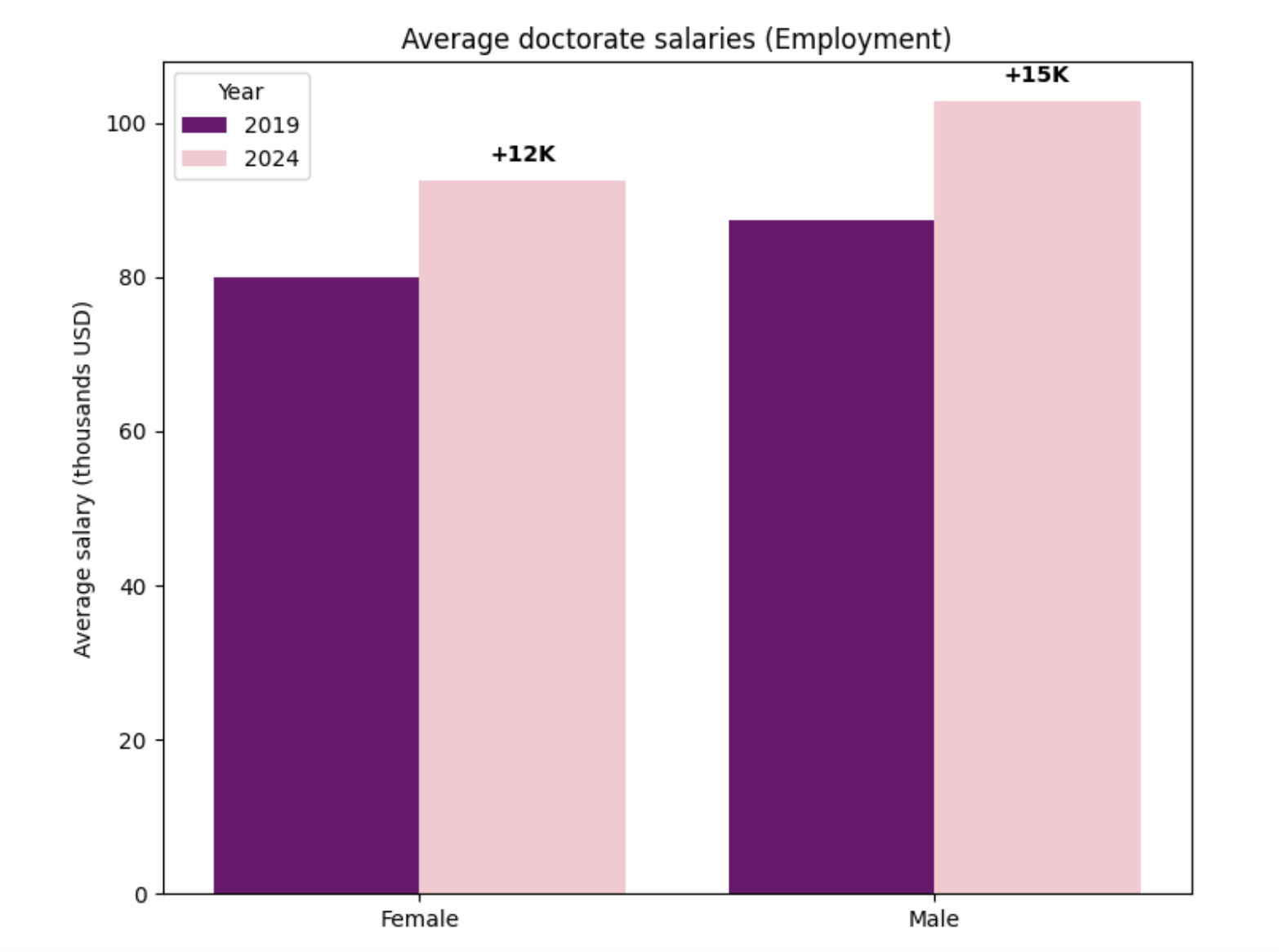
The employment group, consisting of graduates who secured non-postdoctoral jobs, reported the highest salary levels and the strongest growth. Female doctorate recipients in this category increased from almost $80,000 in 2019 to $92,000 in 2024, while their male counterparts rose from $88,000 to $103,000. These values demonstrate that employment provides the most competitive salaries for new PhD graduates and that industry, government, and non-postdoctoral academic roles are prepared to offer significantly higher compensation than other pathways.
By contrast, postdoctoral study continues to function as a lower-paying transitional role. Female postdocs increased their salaries from $51,000 in 2019 to $63,000 in 2024, while male postdocs rose from $53,000 to $64,000. Although these gains are comparable in magnitude to the other categories, the absolute salary levels remain much lower. This illustrates the structural pay gap between postdoctoral appointments and direct employment, reflecting the training-oriented nature of postdoctoral positions rather than their competitiveness in the labor market.
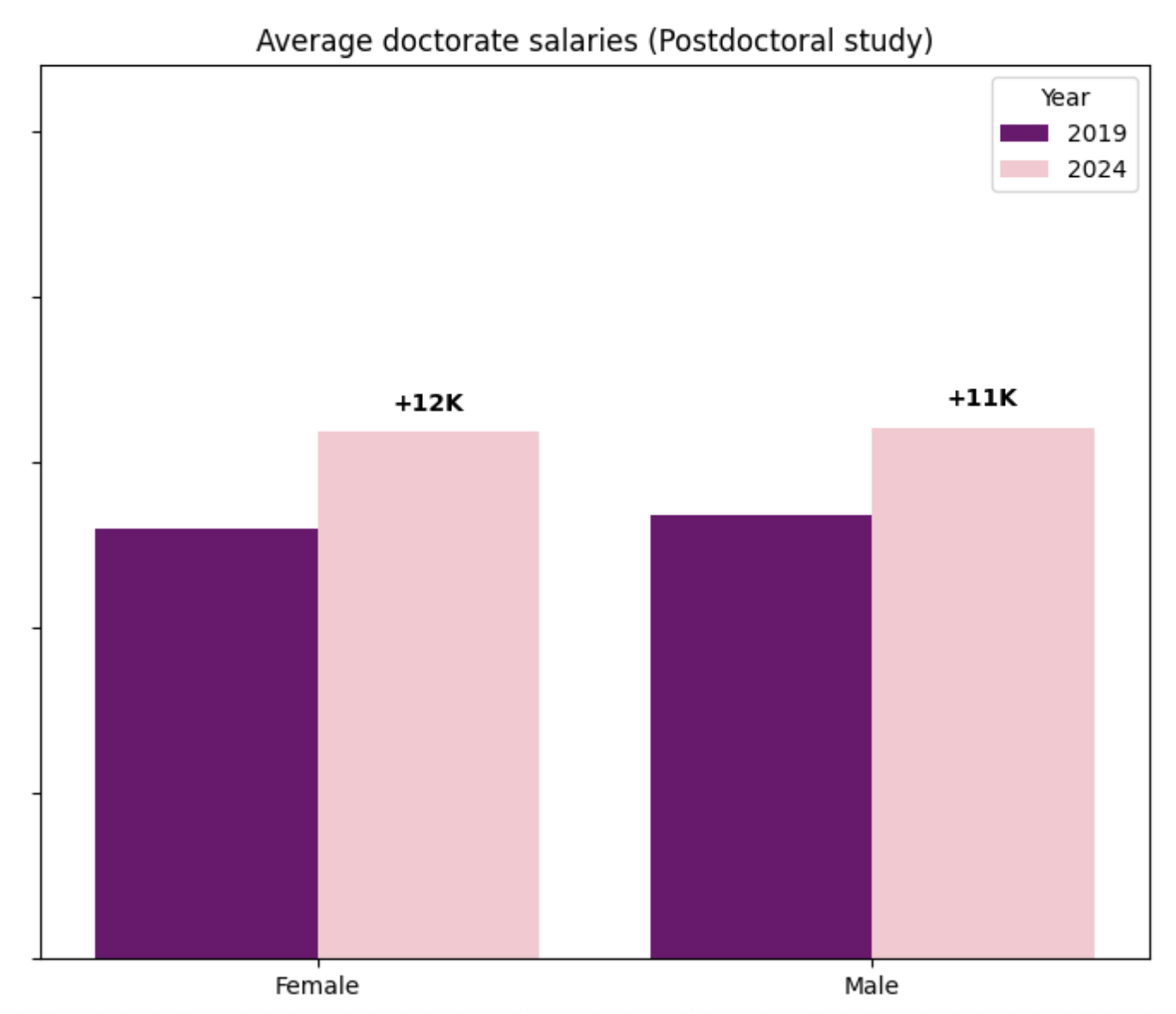
Overall, salaries for doctorate recipients improved across all three categories between 2019 and 2024. However, the differences between groups are striking. Employment clearly remains the most competitive pathway, offering both the highest absolute salaries and the strongest growth, while postdoctoral study continues to lag significantly despite modest increases. Gender differences persist, with men seeing larger absolute gains across categories. Taken together, the analysis shows that the doctoral labor market in the United States rewards direct entry into employment far more strongly than continued academic research training, and that competitive pressures are greatest in sectors outside the postdoctoral track.
Conclusion about the Median annual salaries research
This analysis of NCSES data from 2019–2024 highlights clear shifts in the competitiveness of doctoral fields in the United States. The reclassification of fields in 2021—introducing areas such as Computer and Information Sciences, Multidisciplinary/Interdisciplinary Sciences, and Visual and Performing Arts—reflects the growing importance of technological integration, cross-disciplinary collaboration, and creative sectors.
Salary trends show overall growth across most fields, with the strongest increases in health-, biological-, and nature-related sciences, while Engineering and Computer Sciences maintained high but stable levels. The only decline occurred in Mathematics and Statistics, suggesting reduced demand for purely theoretical expertise.
Across postgraduation paths, employment positions offered the highest salaries and strongest growth, while postdoctoral study remained significantly lower-paying, emphasizing its transitional nature. Gender differences persisted, with male doctorate recipients generally earning more across categories.
Overall, these findings indicate that the most competitive and rapidly advancing fields are those aligned with applied research and emerging societal needs, while the doctoral labor market continues to reward direct employment more strongly than extended academic training.
R&D funding
Introduction
Another relevant statistical report published by the National Center for Science and Engineering Statistics (NCSES), “Trends in U.S. R&D Performance and Funding,” provides essential insights into the evolution of research activity and investment across different scientific and academic fields. This report focuses on research and development (R&D) funding, defined as the financial resources devoted to research—either performed within an organization or transferred to other sectors. Such funding reflects both the priorities of funding institutions and the perceived potential of various disciplines to contribute to innovation and economic growth.
For the purposes of this study, the analysis is limited to the same set of scientific and non-scientific fields examined in the median salary research, ensuring direct comparability between the two dimensions of competitiveness. While the salary analysis captures how the labor market values expertise in each discipline, the R&D funding analysis reveals how financial resources are allocated to support research within those fields. Together, these two perspectives—salaries as labor market signals and funding as investment signals—provide a comprehensive understanding of how different disciplines are positioned within the broader U.S. research and innovation ecosystem.
By examining R&D funding trends from 2010 to 2023, this section aims to identify which fields have attracted growing investment over time and how these patterns align with or diverge from the salary trends observed among doctorate recipients. This combined approach allows for a deeper interpretation of competitiveness, highlighting not only where talent is most rewarded, but also where resources are most strategically concentrated.
Total R&D Investments by Field (2010–2023)
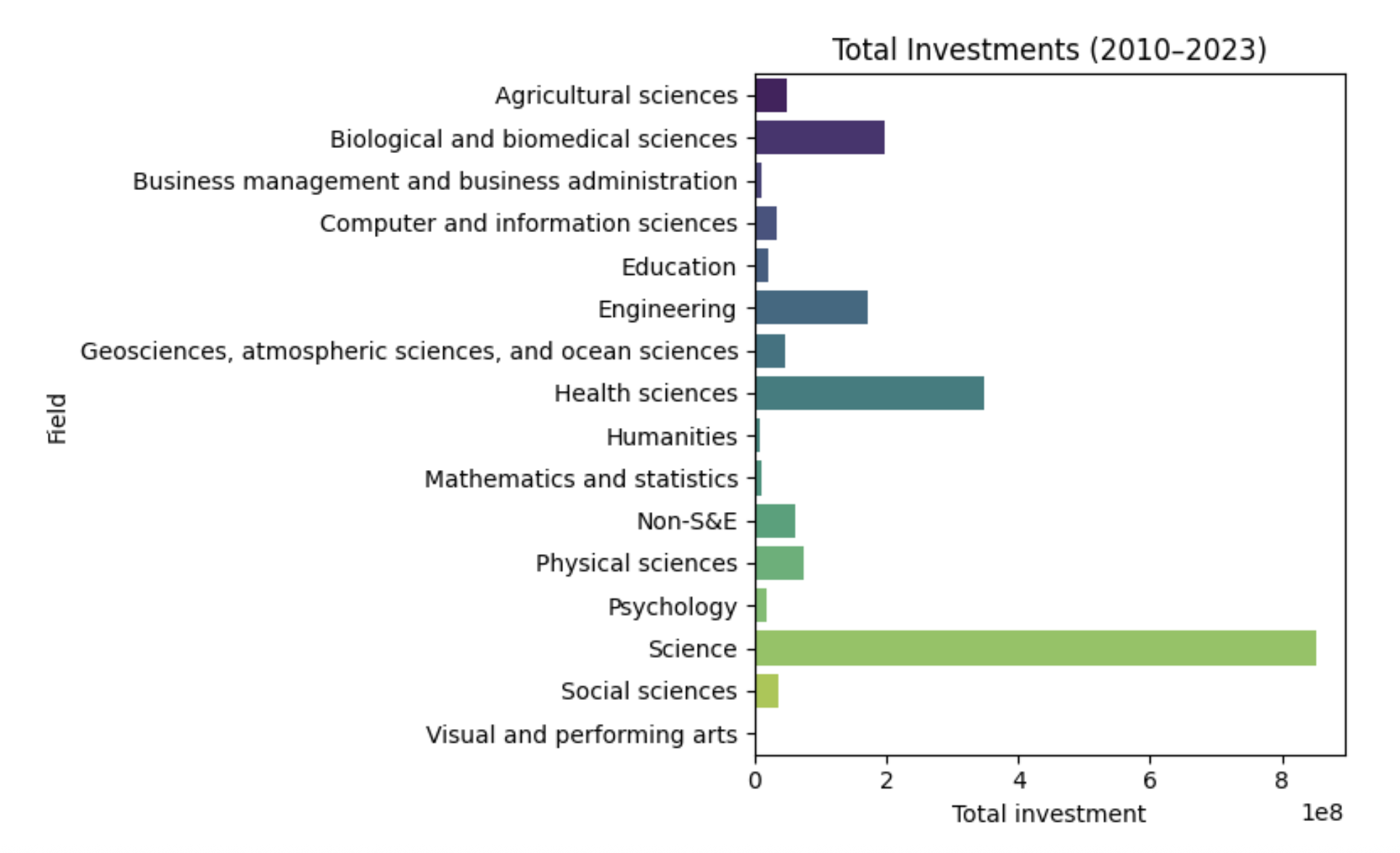
To assess how research funding is distributed across disciplines, total R&D investments between 2010 and 2023 were analyzed for each field. The results highlight substantial differences in financial support, reflecting varying levels of national priority and institutional capacity.
Health sciences received by far the largest share of total R&D funding, underscoring its central role in U.S. research policy and its strong connections to both public health needs and the biomedical industry. Biological and biomedical sciences and engineering also attracted significant funding, confirming their strategic importance in innovation and technology development. Moderate levels of investment were observed in physical sciences, geosciences, and agricultural sciences, suggesting steady but focused support for these foundational areas.
In contrast, social sciences, psychology, education, and humanities received comparatively limited funding, reflecting their smaller research budgets and the tendency for these fields to rely more on institutional or nonprofit sources rather than large-scale federal or corporate R&D allocations. Visual and performing arts registered the lowest total investment, indicating that research activity in this domain remains relatively small in scope.
Overall, the funding distribution reveals a strong concentration of resources in health- and technology-oriented fields, consistent with broader economic and societal trends emphasizing innovation, applied research, and the life sciences.
R&D Investment Trends Over Time (2010–2023)
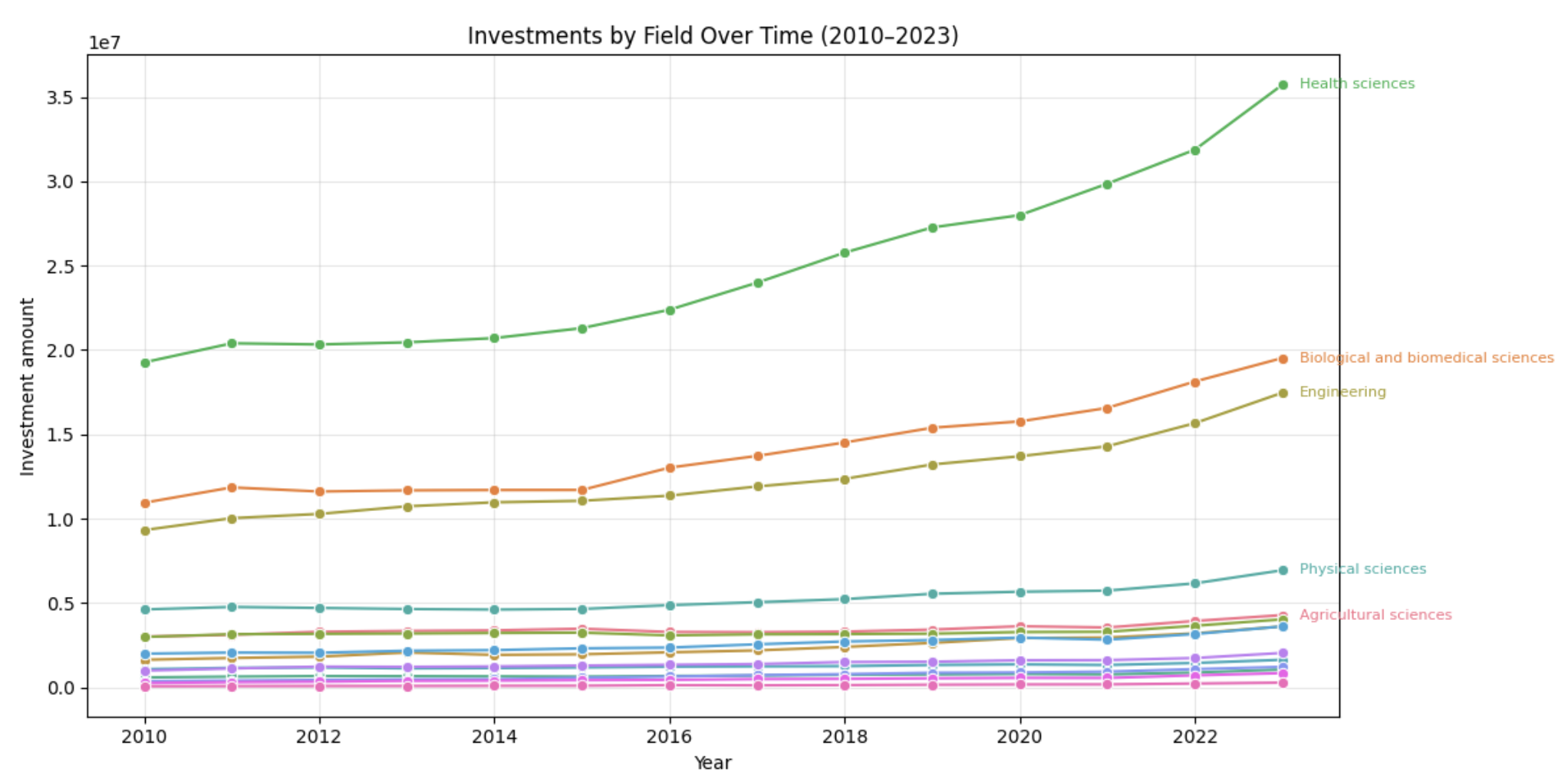
To capture how research funding has evolved, total R&D investments were tracked annually for each field between 2010 and 2023. The results reveal a consistent upward trend in most disciplines, though the pace and magnitude of growth vary considerably.
Health sciences show the most substantial and sustained increase throughout the period, particularly after 2016, when funding began accelerating sharply and ultimately surpassed $350 million by 2023. This reflects both the expanding role of health research in national priorities and heightened investment in biomedical innovation, public health, and life science technologies. Biological and biomedical sciences and engineering also display strong upward trajectories, each showing steady year-to-year growth and confirming their central roles in the U.S. research ecosystem.
Moderate increases are observed in physical sciences and agricultural sciences, indicating stable, long-term institutional support for these foundational research areas. In contrast, most social science, education, and humanities fields exhibit only gradual or minimal growth, maintaining lower funding levels overall and reinforcing their relatively smaller share within the national R&D landscape.
Overall, the data demonstrate that U.S. R&D investment priorities have increasingly concentrated in health-related and applied scientific disciplines. This steady redirection of resources toward life sciences and technology-oriented fields aligns closely with broader societal challenges and economic objectives, emphasizing innovation and impact-driven research.
Conclusion about the R&D funding research
This analysis of NCSES R&D funding data from 2010 to 2023 reveals clear patterns in how financial resources are distributed across research fields in the United States. The results demonstrate a strong and persistent concentration of investment in health sciences, biological and biomedical sciences, and engineering, reflecting the growing emphasis on innovation, technology development, and public health priorities. These fields not only dominate total funding but also exhibit the most consistent upward trends over time.
In contrast, social sciences, education, humanities, and visual and performing arts continue to receive comparatively modest funding, showing only gradual increases over the period. This uneven distribution highlights enduring structural imbalances between applied, high-technology disciplines and fields with less direct economic or industrial application.
Overall, the findings suggest that U.S. research priorities are increasingly aligned with applied and interdisciplinary areas capable of driving innovation and societal impact. When viewed alongside the median salary results, the data indicate that fields attracting the greatest funding also tend to offer stronger labor market outcomes, reinforcing the close connection between research investment, professional competitiveness, and national strategic priorities.
Conclusion
This report provides a comparative analysis of the competitiveness of various scientific and non-scientific fields in the United States by examining two complementary dimensions: median annual salaries of doctorate recipients and R&D funding trends. Together, these indicators offer a comprehensive view of how talent and resources are distributed across disciplines and how the academic and research landscape has evolved in recent years.
The salary analysis (2019–2024) revealed that most fields experienced steady or strong salary growth, particularly in health-, biological-, and nature-related sciences, reflecting increasing labor market demand and societal relevance. Engineering and computer sciences maintained the highest absolute salaries, though with slower growth, indicating market maturity. The only decline occurred in mathematics and statistics, suggesting a shift toward applied and computational skills as key competitive advantages. Furthermore, the analysis confirmed that employment positions remain significantly more rewarding than postdoctoral study, emphasizing the stronger competitiveness of direct labor market entry. Gender differences persist, with male doctorate recipients consistently earning higher salaries across categories.
The R&D funding analysis (2010–2023) complemented these findings by highlighting where long-term financial investment is concentrated. The results showed that health sciences, biological and biomedical sciences, and engineering attract the largest and fastest-growing shares of research funding, aligning with national priorities in health, technology, and innovation. In contrast, social sciences, education, humanities, and arts continue to receive relatively modest support, with limited growth over time. This imbalance underscores the prevailing emphasis on applied, innovation-driven disciplines within the U.S. research ecosystem.
Viewed together, the salary and funding analyses reveal a clear alignment between labor market rewards and research investment priorities. Fields that receive substantial R&D funding also tend to offer higher salaries and faster growth, reinforcing their competitive strength and societal value. Conversely, disciplines with lower funding levels often exhibit slower salary progression, reflecting limited external investment and narrower career pathways.
Overall, the findings suggest that the most competitive fields in the U.S. are those that combine strong research support with high labor market demand—particularly in health, engineering, and life sciences. The growing importance of interdisciplinary and applied areas highlights a continuing shift toward innovation-oriented, problem-solving disciplines. At the same time, persistent gaps across gender and field type point to the need for more balanced investment and equity initiatives within academia and research.
References
OECD. Frascati Manual 2015: Guidelines for Collecting and Reporting Data on Research and Experimental Development. Paris: OECD Publishing, 2015.
Available from: https://doi.org/10.1787/9789264239012-en
OECD. Main Science and Technology Indicators 2023. Paris: OECD Publishing, 2023.
National Science Foundation. Doctorate Recipients from U.S. Universities: 2023. Alexandria, VA: National Center for Science and Engineering Statistics, 2023.
Available from: https://ncses.nsf.gov/pubs/nsf24300
National Center for Science and Engineering Statistics. Trends in U.S. R&D Performance and Funding: 2024. Alexandria, VA: NCSES, 2024.
Available from: https://ncses.nsf.gov/pubs/nsb20257
Data Sources
National Center for Science and Engineering Statistics. Survey of Earned Doctorates: Median basic annual salary data (2019–2024).
Available from: https://ncses.nsf.gov/surveys/earned-doctorates/2024#tableCtr14488
National Center for Science and Engineering Statistics. Research and Development: U.S. R&D funding data (2010–2023).
Available from: https://ncses.nsf.gov/pubs/nsb20257
Tools and Computational Resources
Text refined for clarity using ChatGPT.
Jupyter Notebook (Python) used for data analysis and visualization.
Available from: https://colab.research.google.com/drive/1aeEcYXurTHK7sQzTQ2TyJ3pb6W4kQEdW